Mistake proofing, Poka Yoke, Mistake proofing can be as simple as a piece of paper.
I like it the bun trouble shooting tool.
This blog is designed to give you some pragmatic advice and ideas on how on implementing Lean. I'll use ideas from companies using Lean and others to demonstrate changes to make and how to go about change.
Wednesday, February 23, 2011
Thursday, February 17, 2011
Go see
Just back from doing a Muda walk with a client. A Muda or Waste walk is when you go to the line and deliberately look for examples of motion, transport, unnecessary inventory, waiting, over production, defects and unnecessary processing. We saw a lot of defects and hats of the company for going out there to tackle the problems they now see.
The issue we decided to focus on was a simple one. A package would fall over, stopping the line, requiring an operator to go (run) over reset the package and restart the line. We counted approximately 10 line stops in a 20 minute window.
How to solve this problem, well it is a matter of go see again. Where does the package fall over, pretty quickly the team narrowed it down to a 1 meter section of line. The homework for the team is to identify where exactly it falls over. Then between the operators, supervisor and maintenance the actual cause of the tottering packages will be understood. One thing I know, everything about this old problem is going to be solved by going and seeing.
I'll let you know how they progress on their first quality improvement/waste removal project.
The issue we decided to focus on was a simple one. A package would fall over, stopping the line, requiring an operator to go (run) over reset the package and restart the line. We counted approximately 10 line stops in a 20 minute window.
How to solve this problem, well it is a matter of go see again. Where does the package fall over, pretty quickly the team narrowed it down to a 1 meter section of line. The homework for the team is to identify where exactly it falls over. Then between the operators, supervisor and maintenance the actual cause of the tottering packages will be understood. One thing I know, everything about this old problem is going to be solved by going and seeing.
I'll let you know how they progress on their first quality improvement/waste removal project.
When factories vanish, so can innovators
The last cutlery factory in the US closed, this New York Times article rightly asks how that closure is going to affect innovation.
Link - http://www.nytimes.com/2011/02/13/business/13every.html?_r=1&scp=1&sq=factories%20vanish&st=cse
Tuesday, January 4, 2011
LEI daily check list
Checklists are an overlooked fantastic tool, one of the simplest Poke Yokes out there. Ask your self would you be comfortable flying in an airplane if you knew the pilot and engineer had said to each other "damn it this plane has been checked every other time it’s been flown, we can leave it this one time"? No I doubt you would be happy. Would you be happy to undertake heart surgery or any surgery where the surgeon does not have a before and after check list? I know this is a trick question, many surgeons don't use them thinking that they are above such simple tools.
For yourself do you have a check list to ensure that the daily tasks you as a manager, worker, communicator, leader are being carried out to your satisfaction?
Standard work is not just for those repetitive manufacturing, service or administrative jobs but for any job that has a repetitive element to it. And as management much of our day is actually made up of repetitive elements. They may be different each time they are done and may deliberately not have the same result each time. They each however need to happen and the simple check list may be the best way to ensure they happen
Tuesday, December 21, 2010
Early Christmas present
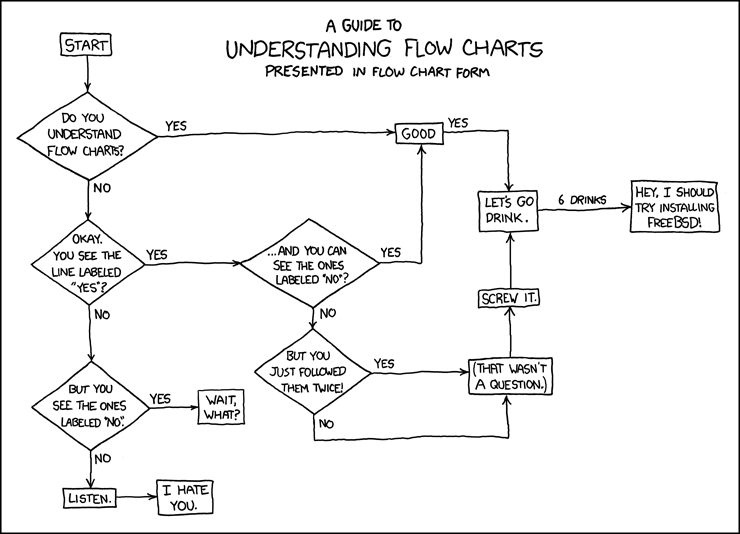
If you have not visited xkcd it's the geek's cartoon of choice, and as a self admitted operations geek I enjoy the humour. Process and values steam mapping and flow charts are a big part of Lean, so thought this would be suitable
An early Merry Christmas
Tuesday, December 14, 2010
The Globe and 'Dismal' productivity
The Globe and Mail has another article on Canadian productivity. There have been a series of these over the last year and it is good to see productivity being discussed as an important business issue.
The article contained one wonderful nugget "The pressure is building for companies to do more with less by investing in new processes to boost productivity". I absolutely love the fact that they talk about processes instead of new the normal new equipment or automation.
I'm hoping that this maybe part of the start of business realizing that processes improvement is a key factor in improving business.
The bad bit and sorry there was one was from David Yager, chief executive officer of HSE Integrated Ltd., a Calgary health and safety services company. First he says its tough to boost productivity. Yes it is tough, business is tough we get on with it. Next he says "there’s not much we can do on productivity,” Lean in the service industry is well established maybe not in Calgary but the ideas are all out there. David when was the last time a business process was mapped at HSE? The tough part I suspect is learning to see the waste in HSE Integrated's business processes, accepting they exist and deciding to do something about them. The big issue is not Government regulation as he claims, Canada is relatively free from regulation, Alberta especially, I'm going say the issue is not wanting to see the waste and do something about it.
End of rant.
Post: http://www.theglobeandmail.com/report-on-business/economy/growth/dismal-productivity-growth-bodes-poorly-for-recovery/article1836771/
The article contained one wonderful nugget "The pressure is building for companies to do more with less by investing in new processes to boost productivity". I absolutely love the fact that they talk about processes instead of new the normal new equipment or automation.
I'm hoping that this maybe part of the start of business realizing that processes improvement is a key factor in improving business.
The bad bit and sorry there was one was from David Yager, chief executive officer of HSE Integrated Ltd., a Calgary health and safety services company. First he says its tough to boost productivity. Yes it is tough, business is tough we get on with it. Next he says "there’s not much we can do on productivity,” Lean in the service industry is well established maybe not in Calgary but the ideas are all out there. David when was the last time a business process was mapped at HSE? The tough part I suspect is learning to see the waste in HSE Integrated's business processes, accepting they exist and deciding to do something about them. The big issue is not Government regulation as he claims, Canada is relatively free from regulation, Alberta especially, I'm going say the issue is not wanting to see the waste and do something about it.
End of rant.
Post: http://www.theglobeandmail.com/report-on-business/economy/growth/dismal-productivity-growth-bodes-poorly-for-recovery/article1836771/
Sunday, December 12, 2010
Calgary's Bow Tower reaches the half-way construction mark
Did a little Googling and found this from the Herald. Interesting fact, no material is on site for more than 24 hours. I can understand that, there is not a lot of spare room available at the site. And it also sounds like they have really thought about how to control the flow of labor on and off site, this is an important issue. I was recently doing some work with a company that does wood finishing for building like the Bow. Getting on site and up to the 25th floor was easy. Getting out was not so, I waited 25 minutes. The company had 8 staff on site and were effectively loosing at least 1 man-day every day waiting for the lift. Everything for the building had to go up or down one service lift, all the trades people, inspectors and material.
From the outsider it was obvious this was a system constraint and needed to be managed, which of course it was not. All the trades were expected to start the same time, times were not put aside for delivery. The lead company did not care what pain the sub contractors were under, they did care they were running late. So hours were extended but the wastes in the system, the free hours that could be solved were not looked at.
Subscribe to:
Posts (Atom)